Where AI Delivers ROI in Consulting Firms and Where Resource Planning and Project Delivery Are Still Catching Up
10 min read
7 min read


AI is everywhere in the conversation. Every conference keynote, every vendor pitch, every LinkedIn post seems to promise that AI will reshape professional services entirely. But for most leaders running project-driven organizations, the practical question remains unanswered: where is AI actually delivering value right now? Not in theory. Not in a pilot. In day-to-day operations.
The gap between the AI conversation and the AI reality has created two camps. Some firms are over-investing in tools they are not operationally ready to use. Others are waiting on the sidelines, skeptical of the hype but increasingly aware they might be falling behind. Neither approach is working.
The 2026 PS benchmark confirms that AI's strategic and operational impact is still forming, but organizations already integrating AI are outperforming those that are not. The benchmark also reveals that AI's benefits are beginning to show across all five performance pillars, and the gap will only widen. The real story is not about replacement or revolution. It is about turning operational data into foresight, and foresight into better decisions.
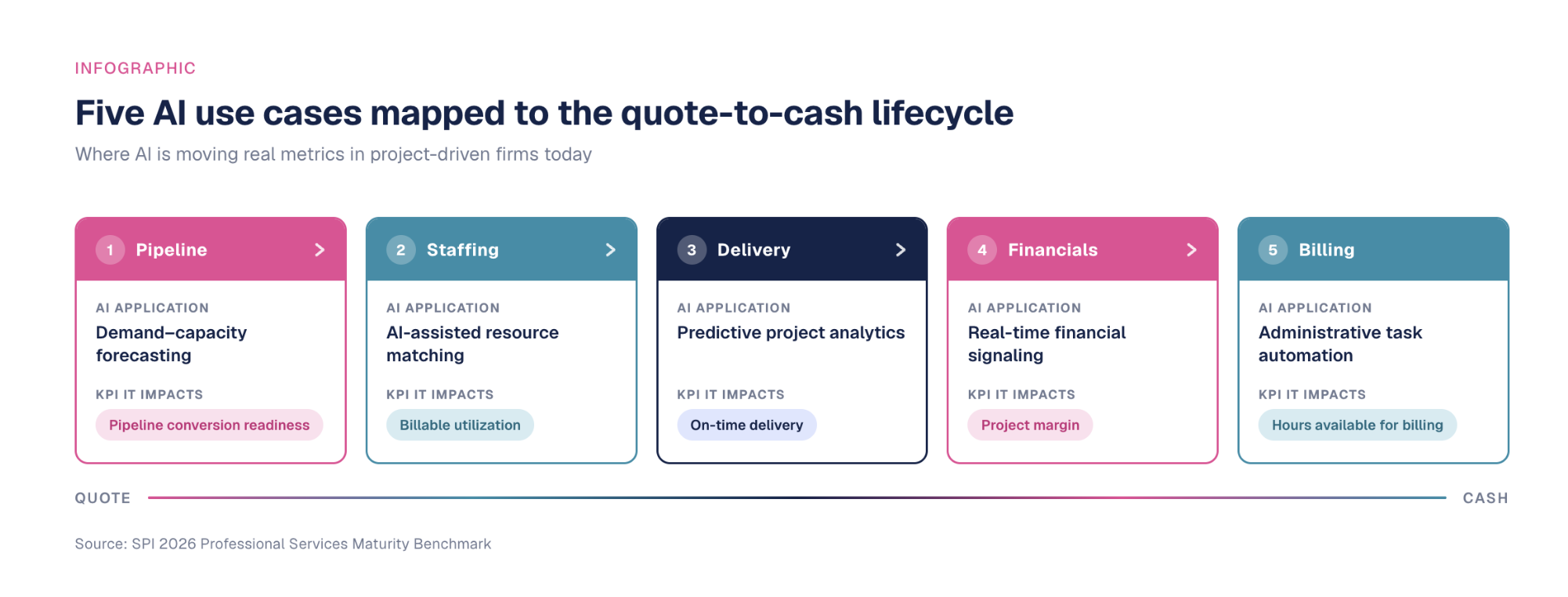
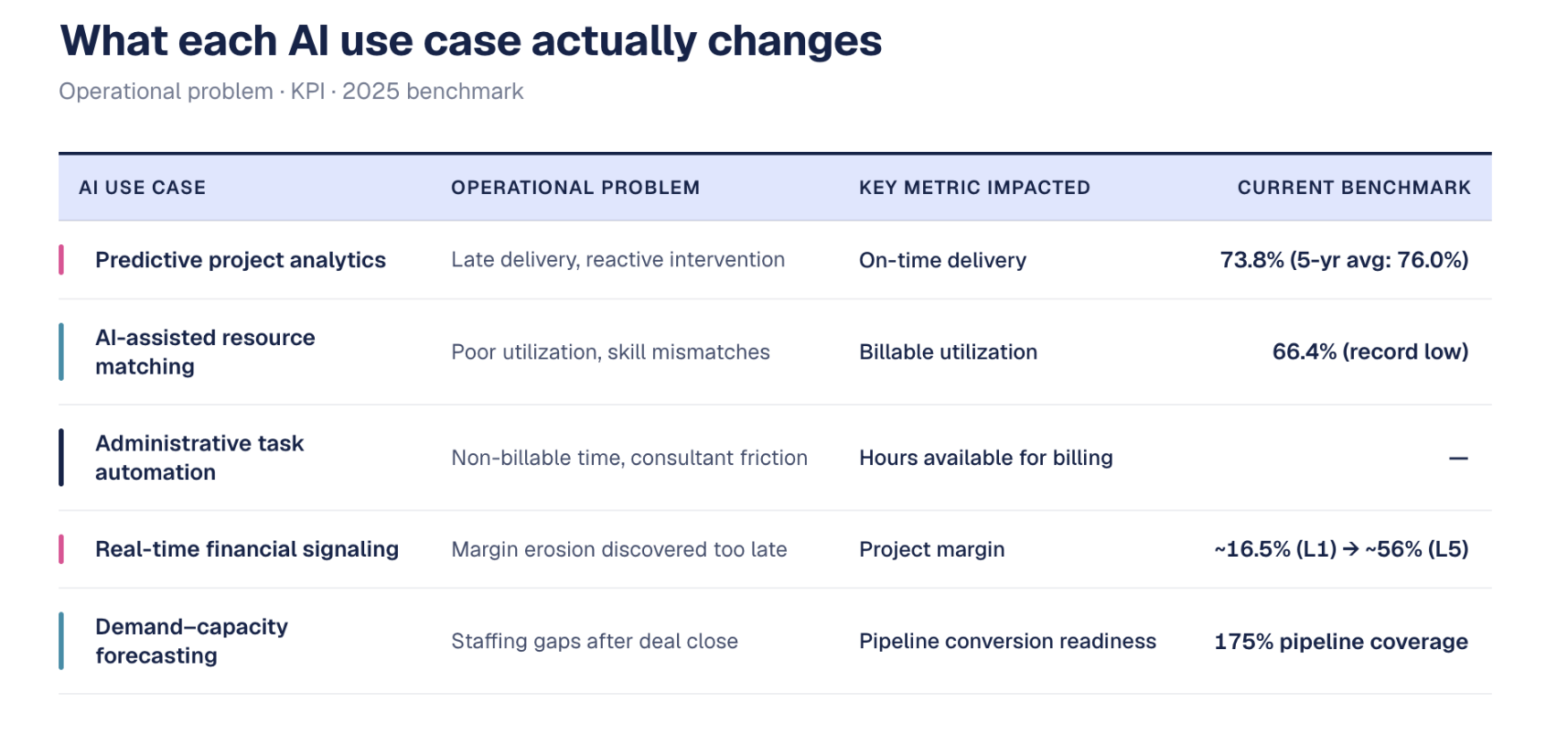
The SPI benchmark tracks over 100 KPIs across the complete quote-to-cash lifecycle. AI's practical value in project-driven organizations maps directly to this lifecycle. Here are the five use cases delivering measurable results today.
On-time delivery in 2025 stands at 73.8%, meaning more than one in four projects is delivered late. That number has barely moved in years. Traditional project management approaches have not fixed it.
Predictive project analytics changes the dynamic. Instead of discovering a project is off track during a monthly review, AI can flag risk signals early: time entries trending above estimate, resource conflicts forming, or scope patterns that match historical overruns. A project manager who gets that signal in week three can intervene. A project manager who gets it in week twelve cannot.
Billable utilization in 2025 fell to 66.4%, the lowest level ever recorded. Firms added headcount at 5.2%, but that capacity is not converting into billable output.
One of the biggest reasons utilization stays low is poor resource matching. The right person is not assigned to the right project at the right time. Resource managers often make these decisions based on who they know is available, not who is the best fit. AI-assisted resource matching recommends assignments based on skills, availability, past project performance, and client preferences.
The result is not just higher utilization. It is better utilization, where the right people are on the right work.
A significant portion of the utilization gap is not caused by a lack of client work. It is caused by non-billable administrative tasks that consume consultant time: filling out timesheets, writing status reports, updating project plans, chasing approvals.
AI that auto-populates time entries based on calendar and project data, generates draft status reports from project activity, or flags missing timesheets before they become a month-end problem gives consultants back hours that can be billed. None of these use cases make headlines. All of them directly address the record-low utilization challenge.
Most firms can tell you project margin after the invoice goes out. Fewer can tell you project margin while the work is still in flight. AI changes that by continuously comparing actual project data against estimates and flagging when margins are trending below target.
For an industry where the gap between top-performing and low-performing firms is driven largely by how quickly problems are detected and addressed, real-time financial signaling is one of the highest-value AI applications available.
Pipeline coverage in 2025 reached 175% of quarterly bookings. As we explored in the five KPI trends every leader should watch, a growing pipeline paired with declining utilization is a warning sign, not a celebration.
AI-assisted demand forecasting connects the sales pipeline to delivery capacity. Instead of discovering a staffing gap after a deal closes, firms can model scenarios: if 60% of this pipeline converts next quarter, do we have the right skills available? Where are the gaps? Should we slow down certain pursuits or accelerate hiring in specific areas?
This is where AI moves from a reporting tool to a planning tool.
Here is the part of the AI conversation that most vendors skip: AI is only as useful as the data it can work with and the workflows it can act on.
The SPI benchmark organizes firms across five maturity levels to Level 5 (continuous improvement, full visibility, PSA integrated with CRM and BI, AI being adopted). That distinction matters enormously for AI readiness.
Every one of the five AI use cases above requires a foundation that only operationally mature firms have in place:
As we showed in why execution has become the real growth strategy, the performance gap between maturity levels is driven by operational discipline, not market conditions. That same gap extends to AI readiness. Level 5 firms benefit from AI because they have already built the infrastructure AI requires. Level 1 firms will not close that gap by buying an AI tool. They will close it by building the foundation first.
The SPI report puts it directly: "Firms that effectively understand, implement, and manage AI solutions are poised for long-term success. The window to build AI capability is now." But building capability starts with operational readiness, not tool selection.
AI amplifies what is already working. It does not fix what is broken.
If you are evaluating AI for your professional services firm, resist the temptation to start with the tool. Start with three questions about your operational readiness.
1. Is your operational data clean, consistent, and connected?
If time tracking, resource planning, project management, and financial data live in separate systems (or in spreadsheets), AI has nothing coherent to work with. The first investment is not in AI. It is in connecting your operational data. A simple test: could you pull your current billable utilization rate right now, today, without asking someone to run a report?
2. Do you have process discipline?
AI recommendations are useless if there is no consistent workflow for acting on them. If an AI system flags a project as at-risk, who receives that alert? What happens next? The firms that achieve 85% on-time delivery do not just have better tools. They have repeatable processes where every project follows the same estimation, staffing, and change control discipline. AI makes those processes faster and more precise. It does not create them.
3. What specific operational problem are you trying to solve?
"We want to use AI" is not a strategy. "We want to predict which projects will overrun so we can intervene earlier" is a strategy. "We want to reduce the time project managers spend on status reporting by 50%" is a strategy. Start with the problem. Map it to the KPI it affects. Then evaluate whether your operational foundation is ready for AI to help solve it.
The AI conversation in professional services will continue to evolve. New capabilities will emerge. But the firms that capture the most value over the next two to three years will not be the ones that adopted the most tools. They will be the ones that applied AI to their most pressing operational challenges, with the data infrastructure and process discipline to make it work.
The path forward is not "buy AI" or "wait and see." It starts with getting your operational data into a connected system where it can be seen, analyzed, and acted on in real time. For firms that have already invested in connected tools and consistent processes, AI is not a leap. It is the natural next step.
Want the full benchmark picture? Download the SPI 2026 Executive Summary.
Coming soon: a practical AI readiness assessment
The most practical AI use cases today are operational: predicting which projects are likely to overrun, recommending resource assignments based on skills and availability, automating administrative tasks like timesheet population and status reporting, flagging margin risk in real time, and forecasting demand against delivery capacity. These use cases directly address the industry's most persistent challenges: utilization at 66.4%, on-time delivery at 73.8%, and the wide margin gap between high-performing and low-performing firms.
Yes, in two ways. First, AI-assisted resource matching helps assign the right people to the right projects, reducing bench time and improving assignment quality. Second, AI can automate non-billable administrative tasks that consume consultant time, such as populating timesheets and drafting status reports. Both approaches free up hours that can be directed toward billable work. However, they only work when the underlying data is clean and systems are connected.
The SPI 2026 benchmark data strongly suggests yes. The firms benefiting most from AI are those at higher maturity levels, where operational data is clean, processes are standardized, and technology is integrated. AI readiness for professional services firms means connected time tracking, project management, and resource planning; consistent project methodologies; and defined workflows for acting on AI-generated insights. Without that foundation, AI adoption adds complexity without delivering value.
Predictive project analytics is one of the most impactful AI applications for delivery improvement. By analyzing patterns in time entries, resource allocation, scope changes, and historical project data, AI can flag at-risk projects before they slip. This allows project managers to intervene early, whether that means reallocating resources, adjusting scope, or having a proactive conversation with the client. With on-time delivery stuck at 73.8% industry-wide, early intervention is one of the fastest paths to improvement.
The data strongly suggests no. AI's value in professional services is not in replacing people. It is in reducing the non-billable friction that prevents people from doing their best work. With utilization at a record-low 66.4%, the problem is not that firms have too many consultants. It is that too much consultant time is consumed by administrative tasks, poor resource matching, and reactive problem-solving. AI addresses these friction points, making consultants more productive and more focused on client work.