
Navigating the Data Dilemma: Challenges and Opportunities in Business
8 min read
5 min read


A project wraps on Friday. The consultant's next engagement does not start for two weeks. Nobody planned for the gap because nobody saw it forming. The resource plan said the consultant was booked through the end of the month. But the project finished early, the next kickoff got pushed, or the client delayed sign-off. By the time the gap is visible, it is already too late to fill it.
Multiply that by 20 consultants across a quarter and you have a significant chunk of revenue that was on the payroll but never billed.
The latest industry benchmark puts billable utilization at 66.4% for 2025, the lowest recorded in nearly two decades of tracking. At the same time, pipeline coverage sits at 175% of quarterly bookings. Firms have more incoming work than ever. The capacity is there. Something in between is leaking.
Low utilization is not one problem. It is five problems that compound each other. Most firms have at least two or three running simultaneously.
The gap between a project being signed and the team being fully staffed is where utilization bleeds first. In many firms, the resource manager only finds out about new work when the project manager asks for help, days after the deal closed. Every day of that information delay is a day of billable capacity lost.
Fix it: Create a formal handoff from sales to delivery that triggers the moment a project is signed. A standardized intake form with scope, required skills, and start date is enough. Then track your staffing speed: how many days from signature to full team assignment? If it is consistently above five business days, this is your highest-return improvement area.
When staffing is rushed, the default is to assign whoever is available rather than whoever is the right fit. A consultant working outside their core skills takes longer, produces deliverables that need more revision, and generates rework that eats hours from other projects. According to Gallup's workforce research, employees who feel their strengths are used daily are significantly more engaged and less likely to leave. Poor matching is not just a utilization problem. It is a retention problem.
Fix it: Build a skills inventory that goes beyond job titles. Include technical skills, industry experience, and development interests. Match against the inventory first, not the "who do I know is free" mental model.
Thirty minutes for a status report. Fifteen minutes chasing a timesheet approval. Twenty minutes updating a resource spreadsheet. No single task feels significant. But across a week, across a team of 50, these small non-billable activities add up to hundreds of hours that never become billable.
Fix it: Ask three consultants to track every non-billable activity for one week. You will likely find two or three tasks that could be automated or eliminated. Common targets: manual timesheet entry, duplicate data entry across disconnected systems, and status reports that summarize information already available in your project tool.
A consultant finishes a project. If no one saw the gap coming in advance, the earliest a new assignment can realistically begin is one to two weeks after the gap is discovered. That is potentially a month of lost utilization for one person. The root cause is almost always visibility. Resource managers cannot see who is coming off a project next week, or the information lives in a spreadsheet that was last updated five days ago.
Fix it: Implement a rolling two-week forward view of resource availability. Every Monday, your resource manager should be able to see which consultants are ending engagements in the next 14 days and what is lined up next. If creating that view requires manually checking multiple systems, that is the gap to close first.
Only 34% of professional services work is now delivered on-site. Before 2020, a lot of utilization management happened informally through physical proximity. Managers could see who was between tasks. That informal visibility papered over process gaps that are now fully exposed.
A consultant finishing early. A team member with 20% capacity freed up mid-engagement. In a remote environment, none of these are visible unless a system is capturing them. The firms that managed utilization adequately in an office-based world but have not adapted their processes for distributed delivery are feeling this leak most acutely.
Fix it: Stop relying on people proactively telling someone they have capacity. Build a system where availability is visible by default. This could be as simple as a shared resource board that updates from project end dates, or as integrated as a connected platform where time data flows directly into a capacity view.
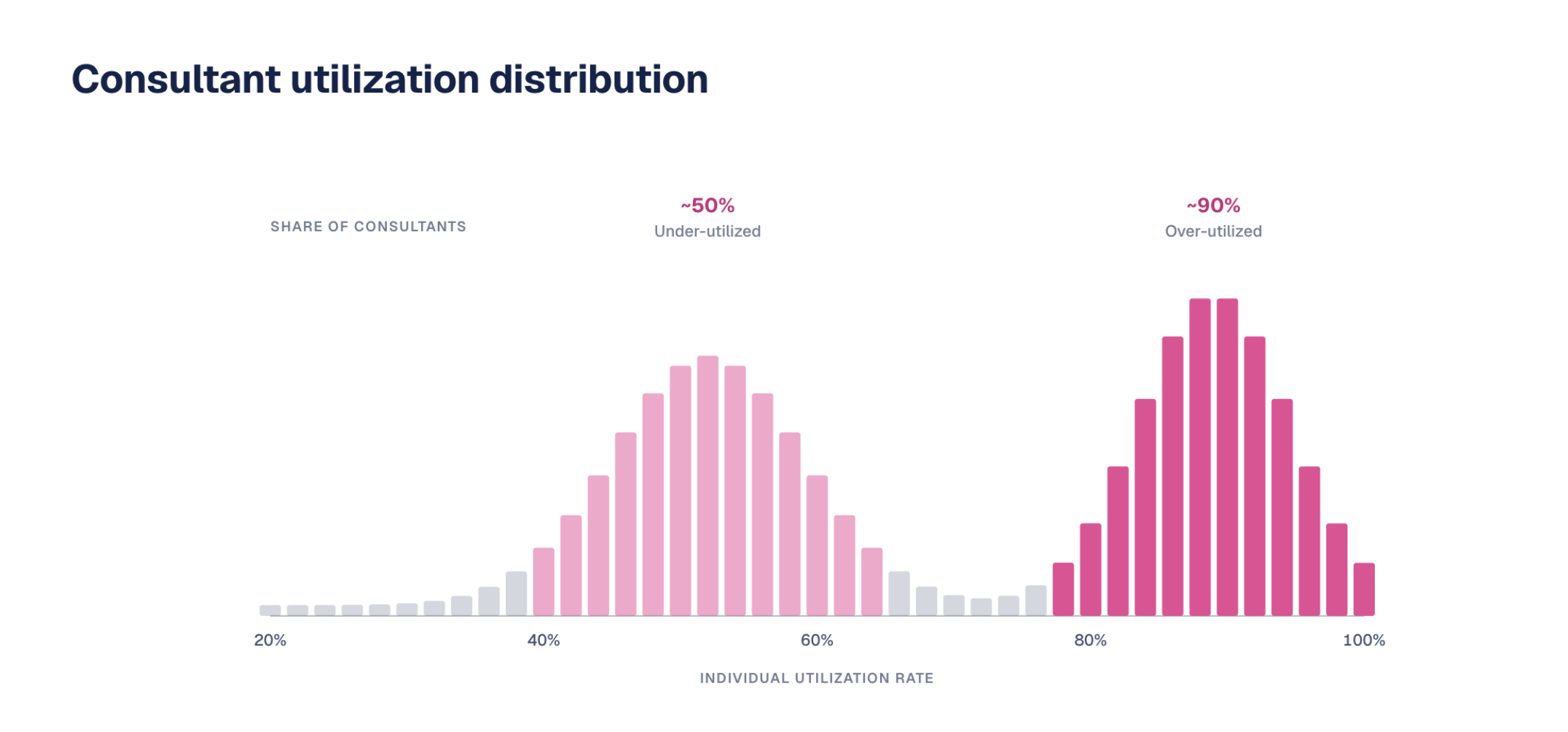
Most utilization conversations focus on the people who are not billing enough. But when overall utilization is low and certain consultants are in high demand, those individuals carry a disproportionate workload. They bill at 90%+ week after week. They say yes because the culture rewards it. And eventually, they burn out or leave. Total employee attrition across the industry is 11.4%, but that number is not evenly distributed. It concentrates among the overworked. Pull the utilization distribution across your team. If you see a cluster in the low 50s% and another above 85%, your utilization problem is actually a workload distribution problem, and it is feeding your attrition risk at the same time.
You do not need a new tool or a six-month project to start. You need honest answers to four questions:
Every one of these questions points to a specific, addressable gap. The firms that close them are the ones moving utilization from the 60s into the 70s and unlocking margin that was already inside the business.
The utilization challenge is not going to solve itself. Nearly two decades of industry data confirm that. What makes the difference is the ability to see capacity in real time and act on it before hours are wasted. When resource planning, project timelines, and time tracking are connected in a single view, utilization shifts from a number you review at the end of the quarter to something you manage every week.
The margin most firms are looking for is not in the next deal. It is in the team they have already hired.
Utilization is one of the five metrics that tell the clearest story about professional services firm health. Download the "5 KPIs Every Professional Services Leader Should Track" one-page guide to benchmark yourself on each one.
Want the full industry picture? Start with the SPI 2026 Executive Summary.
The industry average in 2025 is 66.4%, the lowest ever recorded. Most benchmarking experts consider 75% to 80% a healthy target, though the ideal rate depends on your service mix and delivery model. Top-performing firms achieve utilization in the high 70s%. The gap between average and top firms is driven by operational discipline: staffing speed, skill matching, bench time management, and real-time visibility into capacity.
Pipeline coverage in 2025 is at 175% of quarterly bookings. The disconnect is not demand. It is the operational machinery between a signed deal and a fully staffed, delivering project. Firms lose billable capacity to slow staffing, poor skill matching, administrative overhead, and gaps between engagements that nobody saw coming. Fixing these leaks unlocks revenue without needing a single new deal.
Only 34% of professional services work is delivered on-site in 2025. The shift to remote and hybrid delivery has removed the informal visibility that helped managers spot available capacity in an office environment. Without deliberate systems that surface availability by default, utilization leaks go undetected in distributed teams. Firms that have adapted their resource management processes for remote work report better capacity visibility and shorter bench times.
Low average utilization often masks a workload distribution problem. Some consultants sit at 50% while others are consistently above 85%. The overworked group burns out and eventually leaves, which is why attrition concentrates among a firm's most in-demand people. Monitoring utilization distribution, not just the average, helps identify attrition risk before it becomes a resignation.