
Why Working Harder Won't Move Your Firm Past Low Maturity
11 min read
6 min read


Where Most Firms Look (and Why It Does Not Work)
Targeting the symptom closest to the outcome is the natural response to underperformance, and it produces real but temporary results. Tighter delivery standards improve on-time rates for a quarter or two. A resourcing review lifts utilization. A push on pipeline moves revenue in the short term. Before long, the same metrics are under pressure again.
The firms that consistently outperform are not sustained by better project managers or more disciplined delivery teams in some inherent way. They have built an environment where good execution is the expected outcome rather than the result of individual effort.
Those conditions are specific and learnable. They include how frequently the leadership team reviews data that actually predicts problems, rather than data that describes what has already happened. They include whether there is a visible line between the firm’s strategic priorities and the decisions being made further down the organization. They include whether delivery teams have the information and the authority to surface risks early, or whether the culture makes it easier to absorb an overrun quietly than to flag it while there is still time to act.
When those conditions are absent, a significant portion of leadership energy goes into managing consequences. When they are present, that energy goes into running the business instead.
What Leadership Actually Does in a Professional Services Firm
Leadership in professional services tends to get framed as vision and culture. Both matter, but neither is what separates the firms that consistently hit their numbers from the ones that do not. What separates them is less glamorous: running the business on real information, with clear accountability, toward goals that are actually connected to how decisions get made day to day.
Most leaders would say they already do this. The distance between saying it and doing it consistently is where most firms quietly lose performance.
The difference in outcomes between firms that close that distance and those that do not is substantial. Organizations in the top 20% of performance grow revenue 2.7 times faster than the rest of the market, with on-time delivery running roughly 12 percentage points higher and billable utilization nearly 10 points above average. Revenue per billable consultant in the highest-performing organizations runs at approximately €220,000, compared to €59,000 in the lowest-performing tier. EBITDA in the most mature professional services organizations averages around 27%, while the least mature are operating near zero or at a loss.
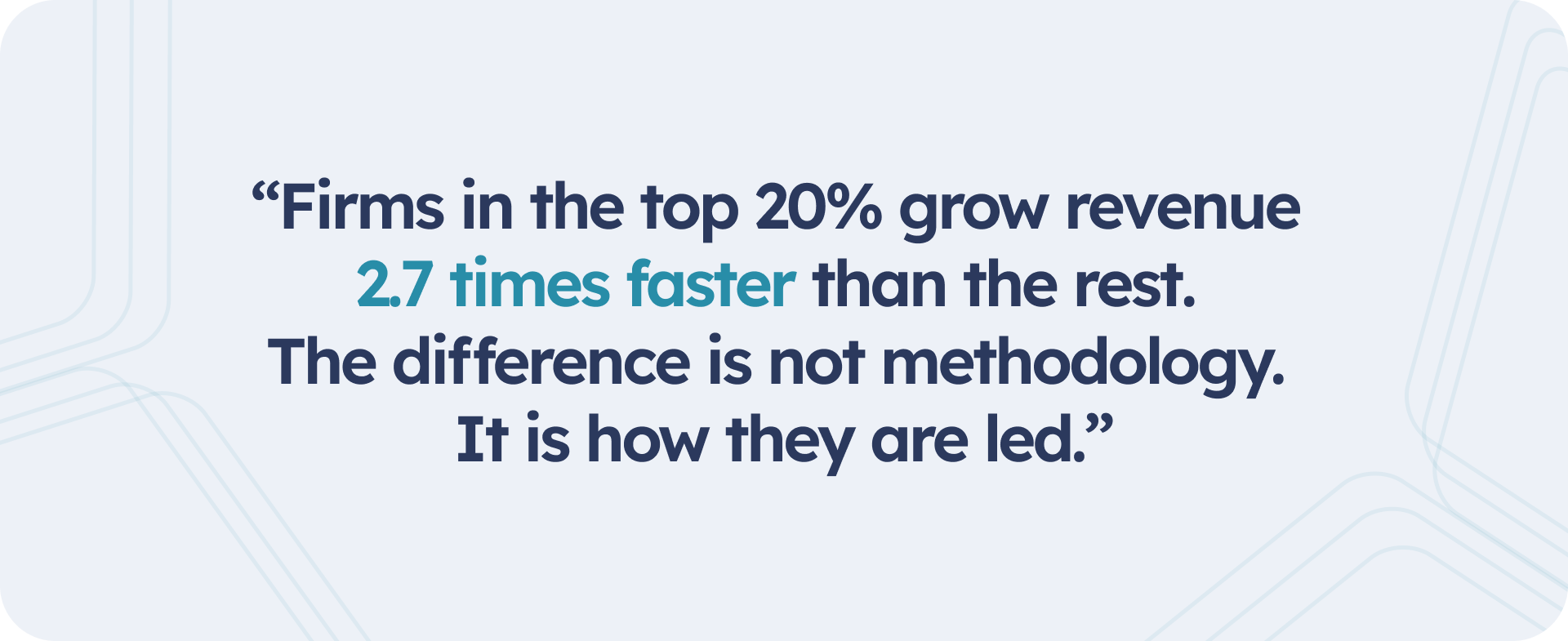
Those outcomes do not come from a stronger sales approach or a more sophisticated delivery framework. They are the result of a leadership function that drives operational discipline consistently, rather than one that responds to operational failure after the fact.
The Six Things High-Performing Leaders Do Consistently
The practices that distinguish the leaders of high-performing professional services organizations from their peers are not personality traits. They are habits that can be observed, assessed, and built.
None of these is complicated in concept. All of them require consistent effort, and that effort is where most firms fall short.
What Separates the Firms That Break Through
The organizations that move from average performance to consistent outperformance tend to go through a recognizable shift in how leadership operates. They stop treating operational problems as isolated issues with isolated fixes and start treating them as signals about the conditions in which the business is being run.
That shift almost always begins with the information environment. Leaders in these organizations start asking different questions. Not “why did this project overrun?” but “what would have told us three weeks earlier that it was heading in that direction?” Not “why is utilization down?” but “where is expert time going that is not showing up in billable hours, and what decision would change that?”

The difference in revenue per billable consultant between the highest and lowest-performing organizations, from €59,000 to €220,000, is the compounding result of better decisions made more consistently over time. The firms that get there are not the ones that found a better delivery framework or rolled out a new CRM. They are the ones where leadership changed how it operated, and the rest of the business followed. For context on what this looks like across the full set of firm KPIs, the pattern is consistent: the metrics that move most are the ones where leadership is most directly implicated.
Three Places to Look First
If you want to understand whether leadership in your organization is genuinely driving performance or quietly limiting it, these are the three most revealing places to start.
How current is your view of the business? If the project health data, utilization figures, or margin forecasts you are working from are more than two weeks old, you are making decisions in an information lag. By the time the picture is clear, the moment to act on it has usually passed.
How much does your team’s understanding of priorities match yours? Ask three people at different levels of the organization to describe the firm’s top priorities for the next six months. The variation in their answers is a direct measure of strategic alignment, and it is almost always larger than senior leaders expect.
Are problems reaching you before they become expensive? If project overruns, scope creep, and capacity issues consistently arrive as surprises, the issue is rarely that the problems happened. It is that the structures around delivery do not make it easy to raise them early, and that is something leadership can change.
None of these are quick fixes, nor are they meant to be. The organizations that improve most consistently do so by building the leadership conditions that make sustained improvement possible across utilization, delivery, margins, and growth at the same time, rather than trading gains in one area for losses in another.
The firms that turn performance around most reliably share one characteristic: the information their leaders need to make sound decisions reaches them with enough time to act. That is what high-quality leadership actually requires, and it is within reach for any organization willing to start at the right level. See how real-time reporting makes that possible.
Key Takeaways
If you want to understand where your firm stands across the five performance pillars, the full industry picture is in one place. Read: The State of Professional Services in 2026.
Frequently Asked Questions
Why do execution problems in professional services firms so often trace back to leadership?
Because leadership sets the conditions under which execution either works reliably or does not. Delivery discipline, resource management, client relationships, and financial performance all improve more sustainably when leadership provides consistent direction, current information, and clear accountability. When those conditions are missing, execution improvements tend to be partial and temporary. The firms that sustain high performance over time are almost always the ones where leadership is actively driving the business, not just responding to it.
What does high-performing leadership actually look like day to day?
It looks less like vision-setting and more like disciplined habits: reviewing current performance data frequently, keeping strategic priorities visible and connected to decisions at every level, setting targets tied to leading indicators, and making it structurally easy for delivery teams to surface problems early. The leaders of the highest-performing firms tend to spend more time in structured performance conversations and less time managing the consequences of surprises.
How do I know if leadership is the issue, or if it really is an execution problem?
The most useful test is whether the same types of problems keep recurring. If projects overrun in the same ways, utilization falls short in the same patterns, or margin compression follows the same path each time, the problem is not execution. Execution problems vary. Recurring patterns point to conditions set above the execution level. A second test: how often do leaders find out about problems in time to change the outcome, versus after the damage is done?
What is the biggest mistake professional services leaders make when trying to improve firm performance?
Starting with the symptom rather than the condition. Most improvement initiatives focus on a specific operational metric: utilization, delivery rate, margins, pipeline. Those are the right things to improve. The mistake is treating them as independent problems with independent solutions, rather than as outputs of how the business is being led. Organizations that address the leadership conditions first tend to see improvements across multiple metrics simultaneously, rather than trading gains in one area for losses in another.
How long does it take to see results from improving leadership practices?
Some effects are visible quickly. When a leadership team starts reviewing more current data and holding more structured performance conversations, decisions change within weeks, and early signals typically show up in project health and resource allocation within a quarter. Larger improvements in margin, revenue growth, and utilization follow over a longer arc, usually six to eighteen months, because they depend on the compounding effect of consistently better decisions over time. The fastest results tend to come from changing the information environment first, because that immediately changes what conversations are possible.