Why Consulting Firms Are Moving to Hourly Billing
9 min read
5 min read


The latest industry benchmark puts on-time delivery at 73.8% in 2025. More than one in four projects deliver late. The number has barely moved in years.
If external factors like difficult clients or complex requirements were the primary cause, late delivery rates would be roughly similar across all firms. They are not. The gap between the best and worst performers is 25 percentage points. The causes are internal. And they follow a pattern that is remarkably consistent.
Let's watch it unfold.
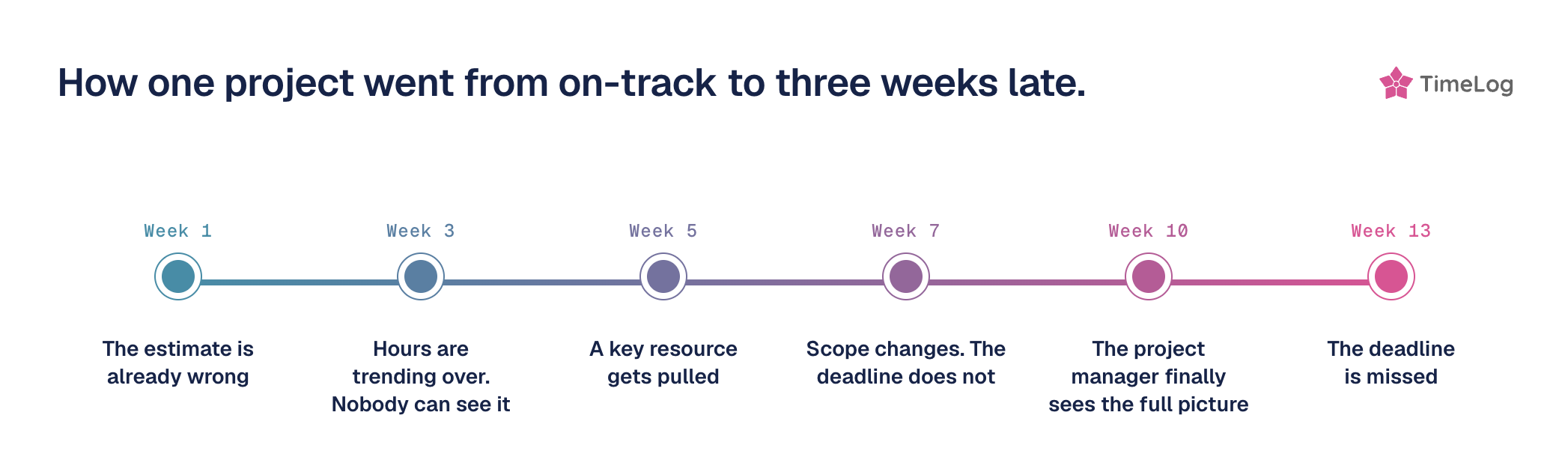
Project Omega is a 12-week consulting engagement. Four team members. A good client. The estimate was built during the sales process in a rush to get the proposal out. It was based loosely on a similar project from last year, adjusted down slightly to fit the client's budget. Nobody checked whether last year's project actually came in on estimate. Nobody accounted for client review cycles. The timeline was set based on what the client wanted to hear.
The project is already behind. Nobody knows it yet.
Two consultants are running 15% above their estimated hours. The technical work is more complex than the proposal assumed. Both consultants figure it will even out. The project manager has not noticed because actual hours live in the timesheet system while project status lives in a separate tool. The two are not connected. She would need to manually pull and compare the data. She manages seven projects. She will get to it at the month-end review.
The senior consultant is reassigned to split her time: 60% on Omega, 40% on a new high-priority engagement. The project manager finds out when the consultant's timesheet shows reduced hours. Nobody recalculated the impact on Omega's timeline. A junior team member picks up the slack but takes longer and needs more oversight, which the project manager absorbs on top of her seven other engagements.
The client asks for an additional reporting module. About 40 hours of work. The project manager agrees because the client is important and pushing back feels risky. An email confirms the addition. The project plan is not updated. The budget is not revised. The deadline stays the same. The team absorbs it.
At the month-end review, the project manager assembles the numbers. Omega has consumed 85% of its budget with about 60% of deliverables complete. The senior resource is split across two projects. Forty unbudgeted hours were added in week seven. The early overruns from week three have compounded into a 25% cost overrun.
The project will be at least two weeks late. Probably three.
Project Omega delivers three weeks late. Margin comes in at 19% instead of the estimated 35%. The client is disappointed. And the project manager spent the last three weeks firefighting Omega instead of managing her other six projects, two of which are now showing early signs of the same pattern.
Every breakdown in Project Omega was a visibility problem before it became a delivery problem.
The estimate was not validated against actual data from past projects. The time overrun was invisible because hours and project budgets lived in separate systems. The resource conflict was not connected to the project plan. The scope change was not reflected in the timeline or budget. The project manager was handling seven projects and could not monitor any of them proactively.
None of these are exotic problems. They are the same five breakdowns that show up in project-driven firms every week. And as research from the Project Management Institute confirms, inaccurate scoping and uncontrolled scope changes are consistently among the top causes of project overruns across industries.
The compounding effect is what makes them so damaging. Each breakdown makes the next one worse. A flawed estimate creates pressure. Invisible overruns delay intervention. Resource conflicts add strain. Uncontrolled scope adds work. And an overloaded project manager cannot catch any of it in time.
The good news: every one of these breakdowns is fixable. Here is where to start.
1. Validate estimates against actuals. Create a simple feedback loop: after every project, compare estimated hours to actual hours by phase. Use that data to calibrate future estimates. Add standard buffers for client review cycles and the "last 10%" that always takes longer than expected.
2. Connect time data to project budgets. When time entries flow automatically into the project budget view, variances become visible the moment they form. The project manager should not need to manually assemble the picture.
3. Make resource commitments visible across projects. Every project manager should be able to see their team members' commitments across all engagements. When someone gets reassigned, the downstream impact on timelines should be visible immediately.
4. Implement simple change control. When scope changes, three things update: the plan, the budget, and the timeline. A one-paragraph change request with updated numbers is enough. The goal is not bureaucracy. It is making the cost of "yes" visible before the team absorbs it.
5. Count your project manager workload. The SPI benchmark is clear: when project managers handle more than five projects, delivery and margins suffer. Count the active engagements per project manager right now. If anyone is above five, compare their delivery outcomes to project managers with fewer projects. The correlation will speak for itself.
The 25-percentage-point gap between the best and worst performing firms proves that. Both groups serve demanding clients. Both deal with scope changes and resource constraints. The difference is that firms with better on-time delivery rates see problems forming earlier and act while correction is still possible.
Every breakdown in Project Omega could have been caught sooner with connected data and manageable project manager workloads. When project data, time data, and resource data live in one place, the warning signs reach the right people while there is still time to do something about them. That is the shift that moves on-time delivery from the low 70s into the 80s.
On-time delivery is one of five metrics that tell the clearest story about professional services firm health. Download the "5 KPIs Every Professional Services Leader Should Track" one-page guide to benchmark yourself on each one.
Want the full industry picture? Start with the SPI 2026 Executive Summary