
How customer feedback helps your company grow
8 min read
6 min read


For most of the last two decades, professional services growth followed a familiar formula: build pipeline, close deals, hire consultants, repeat. When demand was rising and clients were spending freely, that playbook worked. It no longer does.
The SPI 2026 Professional Services Maturity Benchmark now in its 19th year and built on data from 509 organizations representing over 250,000 consultants, paints a clear picture. Revenue growth in 2025 came in at 5.2%, up slightly from 4.6% in 2024, but still roughly half of what the industry historically achieves. The five-year average sits at 8.0%.
Firms are investing in capacity. Headcount grew at 5.2% in 2025. But that investment is not converting into proportional revenue. Utilization dropped from 68.9% in 2024 to 66.4% in 2025, well below the five-year average of 69.8%.
The traditional growth levers (more pipeline, more people, higher rates) are producing diminishing returns. And the firms that recognize this shift are already pulling ahead.
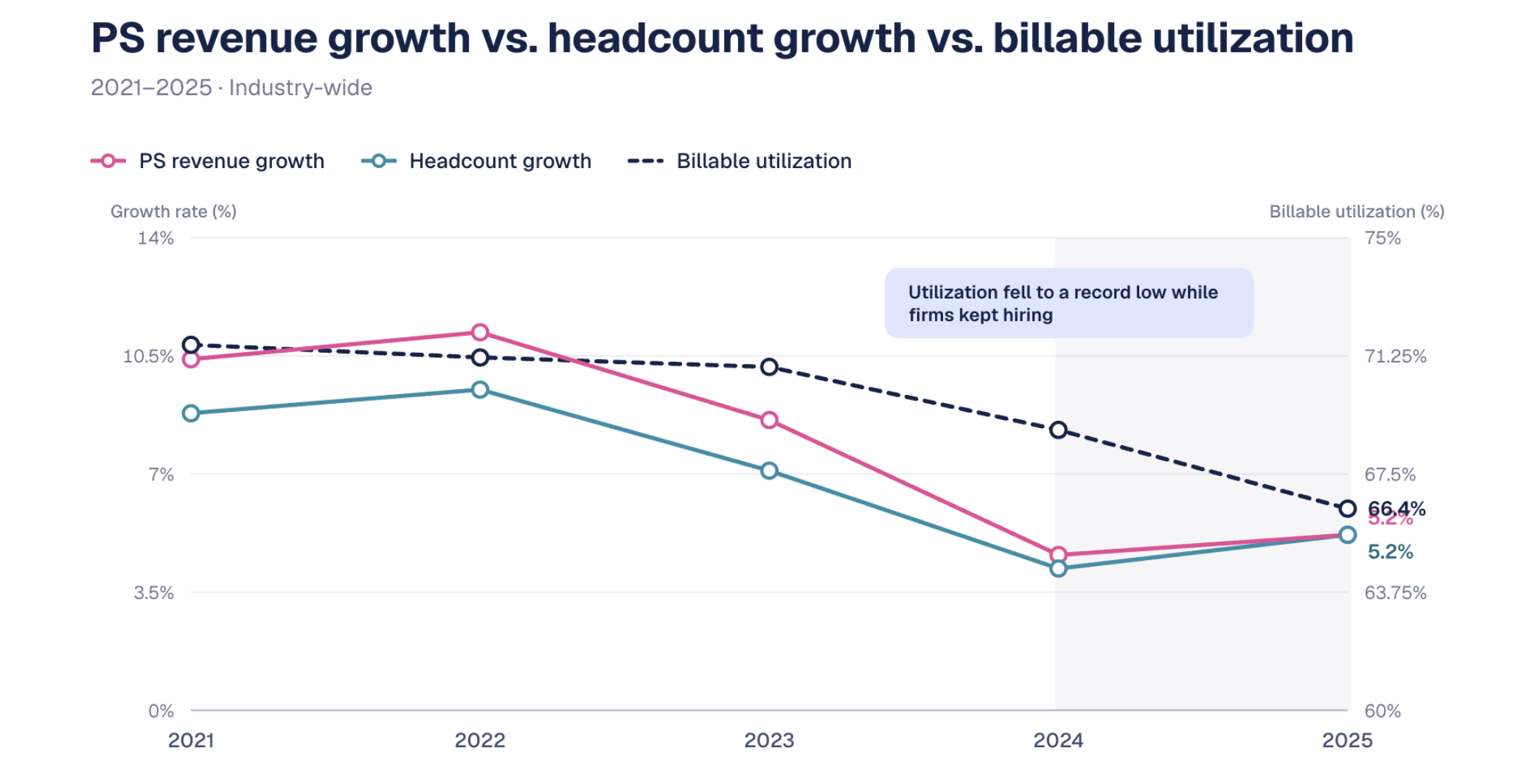
The most interesting finding in the 2025 data is not any single metric. It is what happens when you look at several metrics together.
Project margins rose in 2025. Revenue per billable consultant improved. But utilization dropped to a record low. That combination is counterintuitive. How can firms be making more per consultant while their people are billing fewer hours?
The answer: the firms improving their financial performance are not doing it through volume. They are doing it through better execution on the work they already have.
Here are the numbers that tell the story:
Revenue growth is constrained. At 5.2%, growth is meaningful but far from the roughly 10% rate the industry has traditionally targeted. The five-year average of 8.0% confirms that this slowdown is not a one-year anomaly.
Utilization keeps falling. The drop from 68.9% to 66.4% in a single year is significant. It means firms have more bench time, more non-billable hours, and more capacity sitting unused. Every percentage point of utilization represents real revenue that could have been earned but was not.
On-time delivery is stuck. At 73.8%, on-time delivery barely moved from 73.4% in 2024 and remains below the five-year average of 76.0%. More than one in four projects is delivered late. Late delivery erodes client trust, triggers scope disputes, and compresses margins.
Yet margins improved for firms that execute well. The firms that tightened their estimation, staffing, and delivery processes saw better project margins and better revenue per consultant, even as the broader market softened.
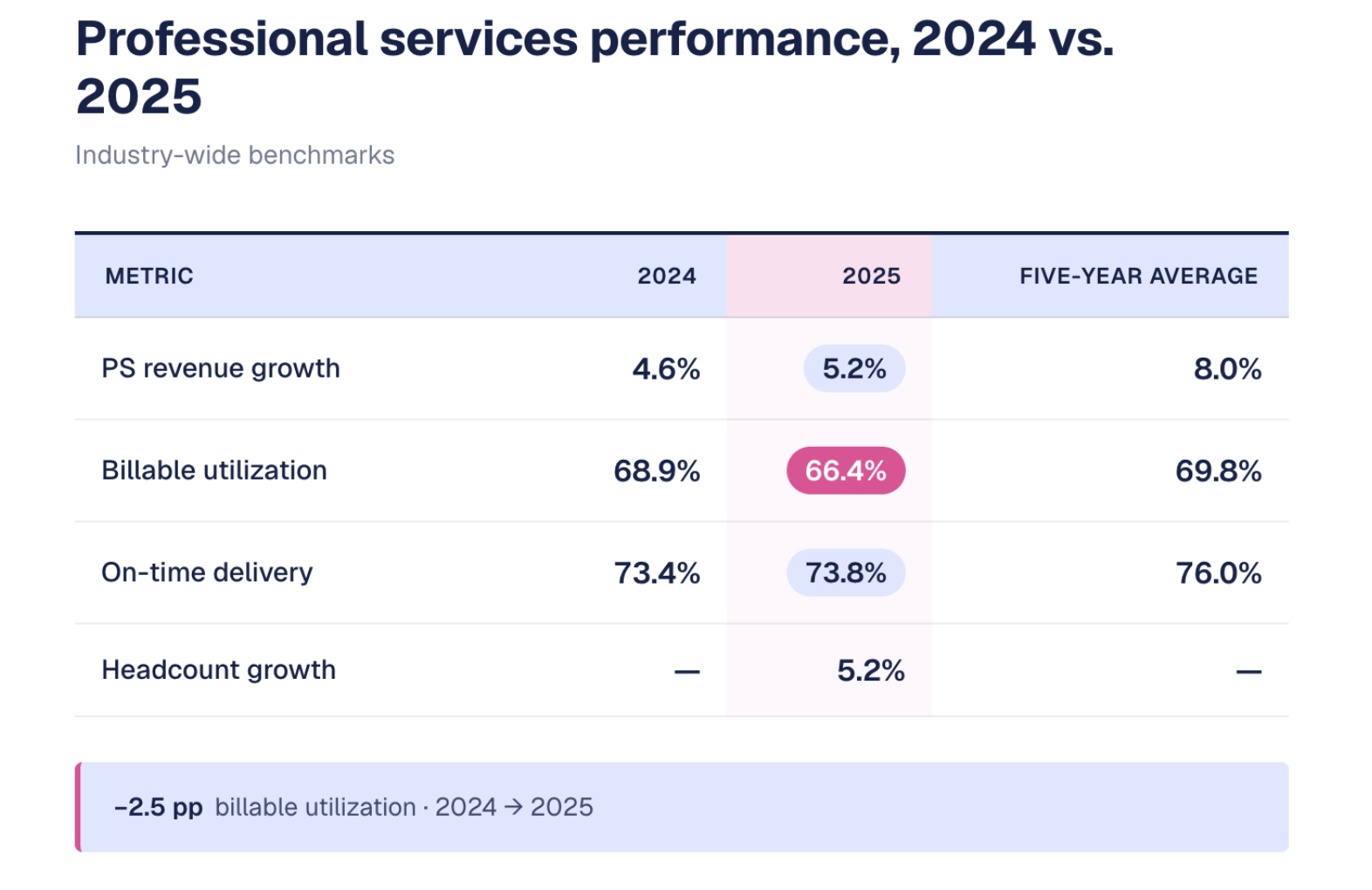
The signal in this data is unmistakable. Firms cannot grow their way out of execution problems. But they can execute their way to better growth.
The gap between the best and the rest in professional services is not a matter of market position, geography, or pricing power. It is a matter of execution discipline.
The SPI benchmark organizes firms across five maturity levels Level 5 firms represent the most operationally mature organizations. Level 1 firms are the least mature. The performance differences between them are staggering.
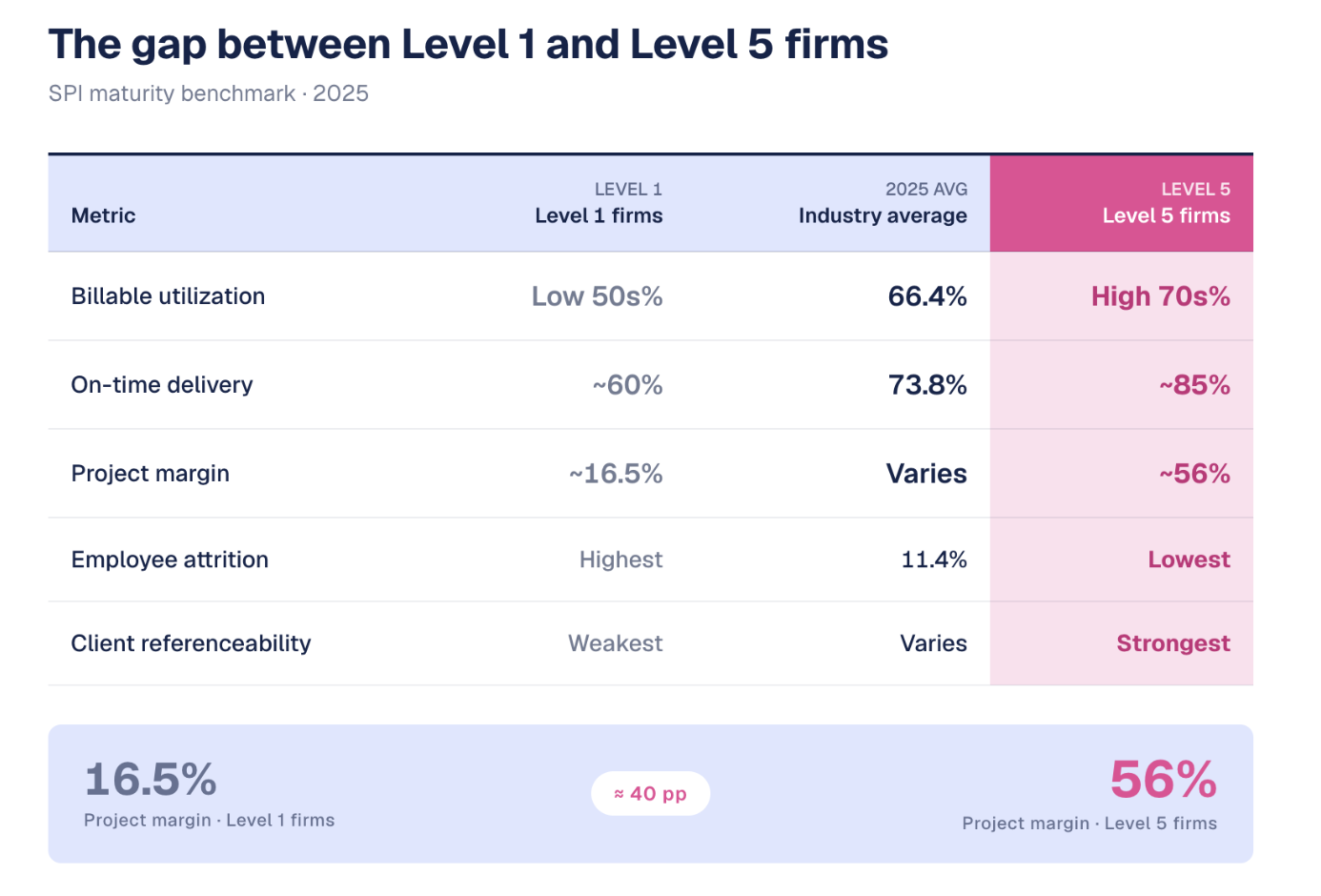
Level 5 firms achieve project margins of approximately 56%. Level 1 firms hover around 16.5%. That is a gap of nearly 40 percentage points, and it is not driven by charging higher rates. It is driven by how work is estimated, staffed, tracked, and delivered.
Three capabilities separate top performers from everyone else:
1. Process discipline across the quote-to-cash lifecycle. Level 5 firms do not rely on heroics or informal coordination. They have repeatable processes for scoping, estimating, staffing, delivering, and invoicing. Every stage is defined, measured, and improved.
2. Real-time visibility into project health. Top-performing firms do not wait for monthly reports to discover a project is off track. They see utilization, project margin, and delivery status in real time. That visibility allows them to course-correct before small problems become expensive ones.
3. Integrated technology. When time tracking, project management, resource planning, and invoicing live in separate, disconnected systems, teams work harder for less clarity. Level 5 firms connect these tools so data flows without friction and decisions are based on current information.
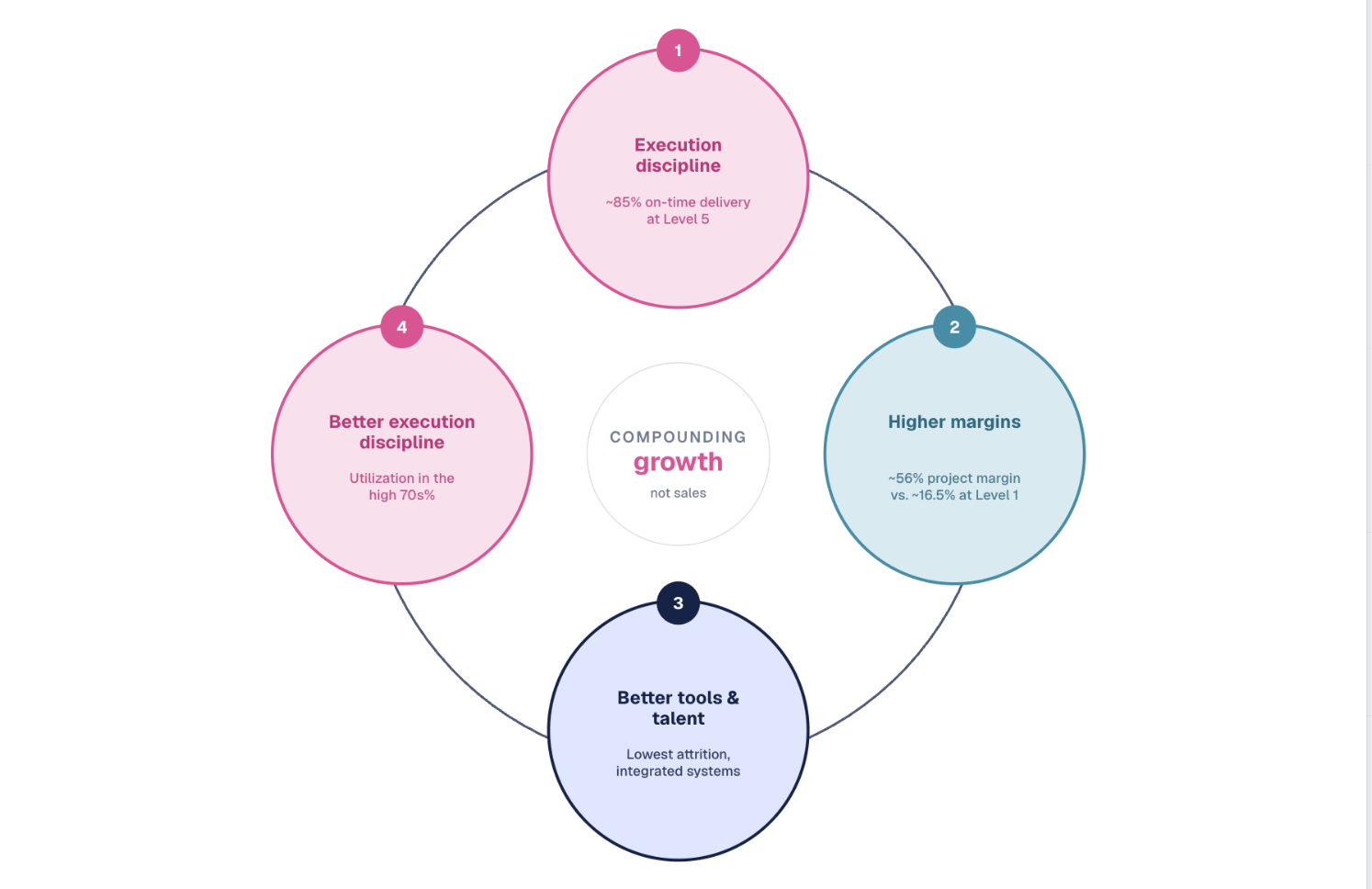
Every one of these advantages compounds. Better execution produces healthier margins. Healthier margins fund better tools and talent. Better tools and talent drive even better execution. It is a flywheel, and execution is what starts it spinning.
The operational discipline behind high margins is worth studying closely. The patterns are remarkably consistent across industries and firm sizes.
The shift from "grow by selling more" to "grow by executing better" is not abstract. It has concrete implications for how you invest your time, budget, and leadership attention.
Before investing further in pipeline acceleration or sales headcount, consider asking five honest questions about your execution capability:
If you cannot answer most of these confidently, the highest-return investment available to you is probably not in growth. It is in execution.
Consider the math. A firm that moves from 66.4% utilization to the high 70s% unlocks revenue that already exists inside the business. No new deals required. Even moving up one maturity level can have a measurable financial impact. A firm that improves on-time delivery from 73.8% to 85% reduces the scope creep, rework, and client friction that silently erode margins on every late project.
These are not theoretical improvements. They are the measurable differences between Level 1 and Level 5 firms operating in the same markets, serving similar clients.
The professional services industry is not in crisis. It is stabilizing. But stabilizing is not the same as thriving, and the firms that treat execution as their primary growth lever will be the ones that pull ahead while others wait for market conditions to improve.
The shift does not require a complete organizational overhaul. It starts with visibility. Firms that can see utilization, project health, and financial performance in real time are able to make better decisions faster. That visibility, paired with connected tools and consistent processes, is what separates a 16.5% project margin from a 56% one.
For firms ready to make that shift, the starting point is understanding where you stand today relative to the benchmark.
Want the full picture? Download the SPI 2026 Executive Summary to see where the industry stands and where the biggest opportunities are hiding.
The industry average in 2025 is 66.4%, which is the lowest level ever recorded in the SPI benchmark. Top-performing (Level 5) firms achieve utilization in the high 70s%. If your firm is below the 66.4% average, there is significant revenue potential sitting unused within your existing team. Even moving a few percentage points closer to the top-performer range can have a meaningful financial impact.
Firms grew headcount by 5.2% in 2025, matching the revenue growth rate of 5.2%. But historically, professional services revenue grows at roughly 8% to 10%. The gap is explained largely by falling utilization. New hires are not being converted into billable output at the same rate, which means firms are paying for capacity they are not using. The issue is not a lack of people. It is an execution and resource allocation challenge.
Level 5 firms in the SPI benchmark achieve project margins of approximately 56%, compared to approximately 16.5% for Level 1 firms. They do this through three capabilities: process discipline across the full quote-to-cash lifecycle, real-time visibility into project health and financials, and integrated technology that connects time tracking, project management, resource planning, and invoicing. These are operational capabilities, not pricing strategies.
In 2025, only 73.8% of projects were delivered on time across the industry, barely up from 73.4% in 2024 and below the five-year average of 76.0%. That means more than one in four projects is delivered late. Level 5 firms achieve on-time delivery rates of approximately 85%, while Level 1 firms sit at approximately 60%. Improving delivery rates directly protects margins and strengthens client relationships.
The SPI 2026 data strongly suggests that for many firms, yes. With utilization at record lows and on-time delivery stuck below 74%, most firms have significant untapped revenue and margin within their existing work. A firm that improves utilization from the mid-60s% to the high 70s% or raises on-time delivery from 74% to 85% is unlocking financial performance without needing a single new deal. That does not mean sales do not matter. It means that for firms with execution gaps, fixing delivery will often generate a higher return than adding pipeline.