
Where AI Delivers ROI in Consulting Firms and Where Resource Planning and Project Delivery Are Still Catching Up
10 min read
6 min read


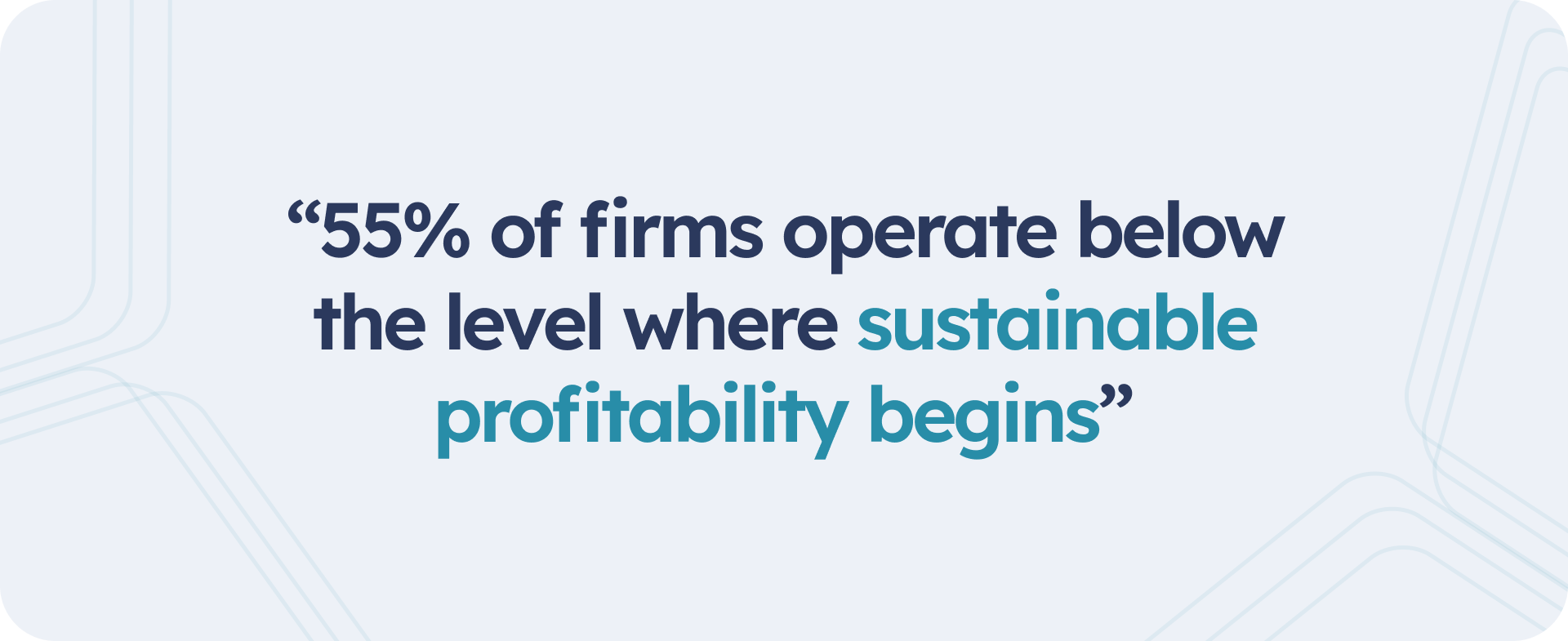
Ask a room of professional services leaders where their organization sits on a maturity scale, and most will place themselves comfortably in the middle or higher. The data tells a less flattering story. Across the latest industry benchmark data from SPI Research, covering more than 500 professional services organizations, 55% of firms operate below Level 3, the point where profitability becomes sustainable rather than occasional. (See how the wider 2026 picture breaks down.)
Low maturity is rarely a story of laziness or lack of ambition. The firms that stall are usually the ones putting in the most visible effort. The problem is that effort and maturity are not the same thing, and a handful of recurring patterns keep hard-working organizations stuck exactly where they are. The point of this article is to name them plainly, because once you can see the pattern, it stops being invisible.
None of these are exotic. They are ordinary, reasonable-looking decisions that feel like progress in the moment and add up to a ceiling over time. Most stuck firms are caught in at least two of them.
The busyness trap: mistaking activity for progress
A full calendar feels like momentum. High activity, packed schedules, and consultants who are clearly stretched all signal that the business is working. The trouble is that being busy and improving project profitability are different things, and one can easily disguise the absence of the other. As Harvard Business Review on the culture of busyness argues, organizations consistently reward the appearance of hard work over the outcomes that work is supposed to produce.
In a low-maturity organization, busyness becomes a substitute for measurement. Nobody steps back to ask whether the hours being logged are the right hours, whether the projects absorbing the most effort are the ones earning the most margin, or whether billable utilization is high in the places that actually generate revenue. The firm keeps moving without ever changing direction.
The tool trap: buying software without changing the work
This is the most expensive pattern, because it looks the most like a solution. A consultancy invests in a PSA platform, rolls it out, and assumes maturity will follow. Six months later the tool is in place but the behavior underneath it has not moved. People still estimate by instinct, still manage scope in email threads, still discover problems after the fact.
The benchmark data makes this uncomfortable to ignore. Adoption of a standardized delivery methodology does not climb in a straight line as firms mature, which means tools alone do not pull an organization upward. PMI's research on standardized project management found that standardizing the underlying process, not simply installing software, is what improves a team's ability to deliver on schedule, on budget, and to the agreed quality. Technology amplifies a process. It does not create one.
The hindsight trap: seeing the numbers too late to act
Many organizations have plenty of data and almost no foresight. They can tell you precisely how a project performed once it is closed and invoiced, by which point every decision that mattered has already been made. Margin erosion is treated as something you discover, not something you prevent.
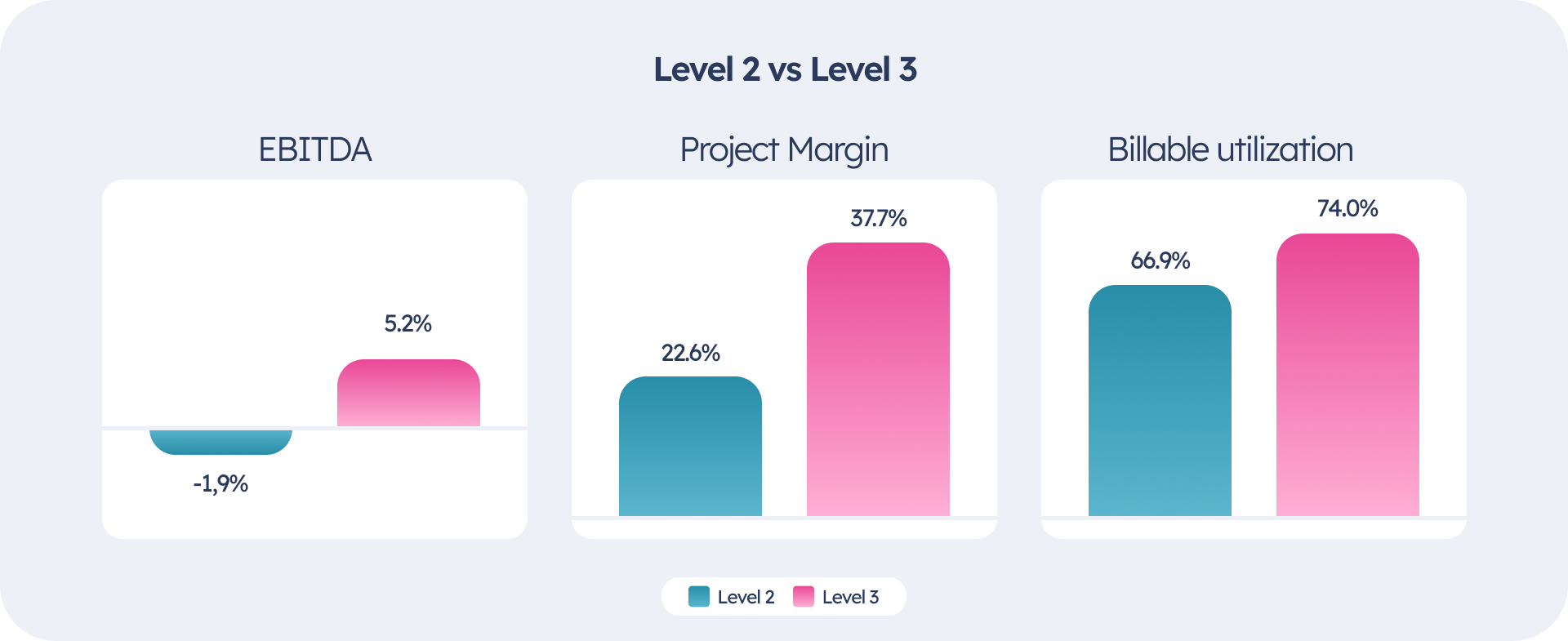
This is the quiet difference between a Level 2 practice and a Level 3 one. At Level 2, the average organization is still losing money, with EBITDA sitting at -1.9%, while Level 1 organizations average -2.0%. At Level 3, that figure turns positive for the first time, reaching 5.2%. The shift is not driven by working harder. It comes from seeing project health early enough to act on it, so that a scope change or a slipping timeline becomes a decision rather than a surprise.
The hero trap: relying on people instead of process
In a lot of stuck organizations, delivery quality rides on a few exceptional people. When the right project manager is on the account, things go well. When they are not, results scatter. This feels like a talent advantage, and leaders are often proud of it, but it is actually a structural weakness disguised as a strength.
Hero-dependent delivery cannot scale and cannot be predicted, which is why it caps maturity. The jump from Level 2 to Level 3 shows up clearly in project management discipline: average project margin moves from 22.6% to 37.7% as delivery becomes consistent rather than personality-driven. The organizations that break through are the ones that turn what their best people do instinctively into something the whole practice does reliably.
What this means for your firm
Each of these patterns is specific enough to act on, which is what makes them fixable. If you want a clear read on where your organization actually stands, work through these questions honestly with your leadership team.
You do not need to fix all of these at once. Picking the one that stings most and addressing it deliberately is how organizations start moving again.
The path forward
Moving up a maturity level is less about a single dramatic change and more about closing the distance between what your organization does and what it can see itself doing. These four patterns share one root cause: decisions get made without the visibility to make them well, so effort substitutes for insight. Replace reactive management with structured, real-time visibility, and the ceiling that has felt so fixed starts to lift on its own.
The firms that break through a plateau are rarely the ones that found a clever shortcut. They are the ones that made performance visible early enough to act, turned their best instincts into repeatable practice, and stopped mistaking motion for progress. When the information that matters reaches the people who need it before a problem hardens into a loss, improvement at every level becomes possible, which is exactly what real-time reporting and project insight is built to support.
Key Takeaways
If your firm recognizes itself here, the next question is what to do about it, and that starts with treating delivery, not pipeline, as where growth is actually won or lost. That argument is worth reading in full: execution, not pipeline, is where growth is won or lost.