Where AI Delivers ROI in Consulting Firms and Where Resource Planning and Project Delivery Are Still Catching Up
10 min read
schedule Time tracking
Build your perfect data foundation for spotless invoicing and deep business insights with easy time tracking.
assignment Project management
Be a world champion project manager. Keep your projects on track - and profitable.
groups Resource management
Efficiently staff projects and run a predictable business with confidence.
search_insights Insights & Reporting
Get smarter - faster - to make clever decisions for long-term growth impact.
receipt_long Project accounting & Invoicing
Invoice everything - fast and accurate - while staying on top of project finances.
checkbook Staff & Salary
Give accountants and HR an intelligent tool to eliminate draining administration.
chevron_right View all features of TimeLog PSA
account_balance Financial Systems
TimeLog offers standard integrations for all your favourite financial systems. Save time and reduce manual tasks.
payments Payroll Solutions
TimeLog offers standard integrations for multiple payroll solutions. Get easy salary administration and only enter payroll information once.
extension Add-ons
Track time automatically via Outlook, use gamification or find another add-on that can support your business.
corporate_fare Multiple Legal Entities
You can create synergy between your departments and across borders and offices with the Multiple Legal Entities module from TimeLog.
analytics Business Intelligence
Utilise the insights you get from TimeLog to the fullest. Our system is ready to integrate with multiple BI solutions.
hub Partner Integrations
TimeLog PSA is part of a large ecosystem. Get an overview of all the partner integrations in the TimeLog family.
account_balance Economy department
Save 1-2 days a month on your invoicing process.
assignment_turned_in Project teams
From planning to execution and evaluation. Robust tools for every project manager.
leaderboard Management teams
Create a performance-driven culture with solid reporting capabilities.
domain Large enterprises
Enhance operations and performance across entities, countries and departments.
volunteer_activism NGOs and non-profit organisations
Simplify internal processes, spend less time on administration, and get documentation in place - at a discounted rate.
article Blog
Get inspired to run an even better business with articles, guides and analyses.
menu_book Guides, podcasts and webinars
Get access to templates, guides and webinars that help and inspire you.
live_help Help Center
Looking for help material and user guides to the TimeLog system? Look no further. Find all the help you need now.
verified Get a single source of truth
Discover how companies maintain a single source of truth across borders, departments, and currencies.
integration_instructions Get integrated
Discover the advantages customers gain from utilising our integrations and API.
query_stats Reporting in real-time
Explore how others leverage reporting to optimise their processes and make informed decisions.
event_available Get started with resource planning
Discover how other companies thoroughly grasp their resources and enhance their ability to predict future trends.
trending_up Improved project financials
This is how the efficient financial toolbox from TimeLog helps project managers and CFOs improve their project financials.
bolt Faster invoicing
Discover how other companies have slashed the time spent on invoicing by 75% - and uncover how you can achieve the same efficiency.
arrow_forward View all cases now
history_edu The Story of TimeLog
Get insights on TimeLog and how we can help you grow and evolve your business.
groups Employees
See who shows up every day to deliver the best PSA solution.
work Career
What's life like at TimeLog? Are we hiring? Get the answer here.
handshake Partner
Create even more value for your customers, as well as ours, as a TimeLog Partner.
support_agent Premium Service
Online Help Center, tailored onboarding and support from Day 1.
public Corporate Social Responsibility
We work to ensure a positive impact on planet, people and businesses.
security Security and GDPR
Learn more about how we work to keep your data safe and provide maximum security.
5 min read
Time and materials is the fastest growing contract structure in consulting.
Billing by the hour or by the day makes more difference to margin than most expect.
Time and materials now accounts for 43.5% of all professional services work globally, up from 39.6% the prior year. In EMEA the rise has been particularly sharp, from 33.6% to 47.5% in twelve months. For most consulting firms operating in Denmark and Sweden, that means the majority of active engagements are already running on this model. What many of those firms have not revisited is whether the way they apply it is actually working in their favor.
Under a daily rate, a consultant who completes a piece of work in six hours bills one day. The remaining time goes unrecorded. The efficiency the team delivered benefits the client as unearned capacity rather than the firm as captured revenue. Under hourly billing, six hours of work is six hours of revenue, and every productive hour the team puts in is reflected in what gets invoiced.
The daily rate model trades some upside for simplicity. For short, well-scoped engagements that trade-off can be acceptable. For firms running twenty or thirty active time and materials projects simultaneously, the accumulated effect is material. It runs consistently in one direction, transferring value from the service provider to the client on every engagement where delivery is more efficient than the daily rate assumes.
Some firms have raised the question of whether AI changes this equation. If delivery teams become faster through AI tools, does hourly billing start working against the firm? The data does not support that concern at this point. Time and materials is growing, and firms moving to hourly billing are seeing improved margins rather than compressed ones. Efficiency gains are currently flowing to the firm rather than away from it.
The reason time and materials has grown so sharply is not that clients have become more flexible. Specialist talent has become harder to find, and that scarcity has shifted the commercial balance. IT consultancies, engineering firms, and management consultancies with the right people are finding that clients have less room to push for fixed-fee terms when the alternative is not getting the expertise they need. Over half of all IT consulting work is now sold on a time and materials basis.
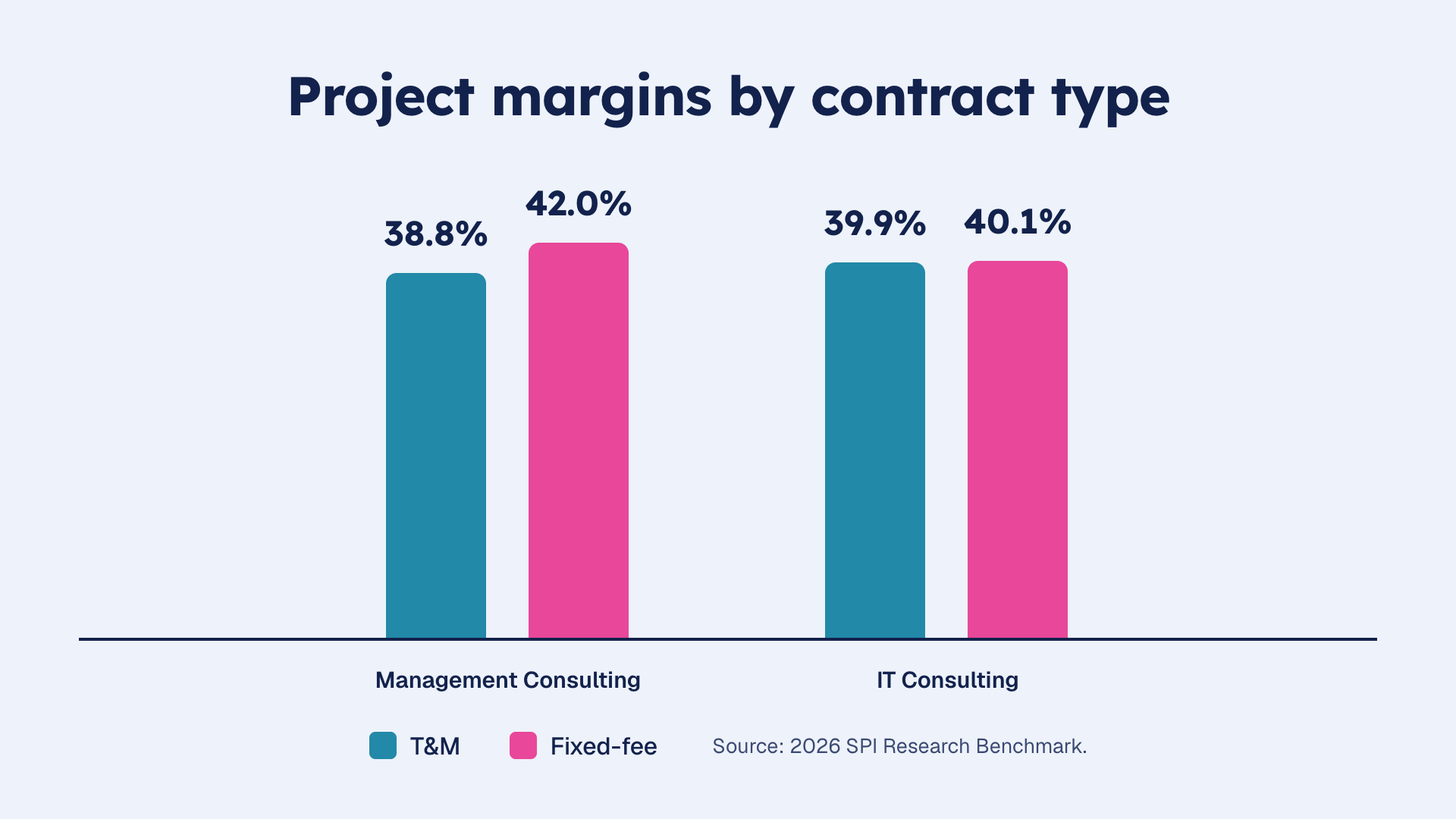
Fixed-fee still produces strong results where it fits the work. Management consultancies achieve 42.0% project margins on fixed-fee engagements, slightly ahead of their 38.8% on time and materials. IT consultancies run nearly identical margins across both. The model works well when scope is defined clearly and the firm has the estimating discipline and real-time cost visibility to hold to the price it quoted. Where those conditions do not exist, fixed-fee is where margin quietly disappears.
Across the 2026 SPI Professional Services Maturity Benchmark, the top 20% of firms sell 51% of their work as time and materials, compared to 41% for the rest. They carry a deal pipeline worth 224% of their quarterly bookings target and win 56.5% of bids against 45.1% for their peers. They grow revenue 2.7 times faster than the market average.
These firms are not holding firmer on billing structure because they negotiate better. Their pipeline depth means no single deal is make-or-break, which changes the character of every conversation about rates, billing frequency, and contract terms. Their billing mix reflects the commercial position they have built. It is the outcome, not the strategy.
The firms most likely to concede on contract structure tend to be the ones who can least afford to.
Moving from daily to hourly billing is less a client management challenge than an internal readiness question. Most clients accept hourly billing when it is presented clearly and invoiced without friction. The requirement is on the firm's side. Hourly billing needs time tracking that consultants actually use consistently, not reconstructed at the end of the week from memory. It needs billing processes that close cleanly. It needs enough visibility into hours delivered versus hours planned that a project manager can see a discrepancy before it becomes a client conversation rather than after. Without that infrastructure, daily rates are not a choice. They are a necessity, because hourly billing requires a level of operational precision the firm has not yet built.
Firms in this market record the lowest average operational maturity of any region in the benchmark at 2.25, against a global average of 2.40. That gap shows up across multiple measures, but billing precision is one of the most direct. The firms closing it tend to find the same thing: the revenue left on the table through imprecise billing is larger than it looked before they measured it. TimeLog's revenue leakage calculator is a useful starting point for firms that want to put a number on it.
Managed services and subscription contracts account for 13.8% of the market and are relevant here for a connected reason. A firm that re-wins its entire revenue base every quarter operates under conditions that make it harder to hold firm on billing structure. End-of-quarter pipeline pressure is exactly when daily rate defaults and fixed-fee concessions tend to get made. A firm with meaningful recurring committed revenue going into each quarter starts those conversations from a fundamentally different position.
Building recurring revenue and tightening billing precision are separate initiatives, but they share the same underlying logic: the more control a firm has over how its revenue is structured, the more of it tends to be retained.
Key Takeaways
If you want to understand what billing gaps are costing your firm, TimeLog's revenue leakage calculator gives you a useful starting estimate based on your own team and rates.

Hourly billing gives firms a direct connection between delivery effort and revenue captured. Under daily rate time and materials contracts, any consultant time saved within the working day benefits the client rather than the firm. As time tracking tools have become more reliable and delivery teams more efficient, the financial case for hourly billing has become clearer. TimeLog's time tracking connects directly to project cost visibility, making the switch from daily to hourly straightforward to manage operationally.
Under a daily rate, a consultant is billed at a fixed fee per working day regardless of hours worked. Under hourly billing, revenue maps directly to time spent. For time and materials engagements, hourly billing means efficiency gains stay with the service provider. Daily rates pass those gains to the client on every engagement where delivery runs faster than the daily assumption. Most EMEA consulting firms still default to daily rates, while North American firms predominantly use hourly billing.
Neither model is inherently better. Management consultancies achieve slightly higher margins on fixed-fee (42.0%) than time and materials (38.8%). IT consultancies run nearly identical margins across both at around 40%. The outcome depends on whether the firm has the estimating discipline and real-time cost visibility to execute the chosen model at the price it quoted. TimeLog gives project managers live visibility into cost versus budget so that both models can be managed to planned margins rather than discovered at close.
The concern is understandable: faster delivery through AI could reduce billable hours and compress revenue. The benchmark data does not support that outcome at this stage. Firms moving to hourly billing are reporting improved margins rather than reduced ones, and AI efficiency gains are currently flowing to the firm rather than away from it. The firms best positioned to benefit are those with time tracking precise enough to capture productivity gains accurately across their delivery teams.
Revenue leakage from billing gaps typically comes from hours worked but not recorded, time captured but not invoiced, and daily rate structures that absorb consultant efficiency without recovering it as revenue. The starting point is measuring the gap between hours worked and hours billed across active projects. TimeLog's revenue leakage calculator gives firms a personalized estimate based on their own team size and billing rates, and connects directly to the time tracking and invoicing processes where those gaps most commonly occur.
10 min read
Read more
8 min read
Read more
11 min read
62 min read