New to project financials? Learn which processes and KPIs to master
13 min read
5 min read


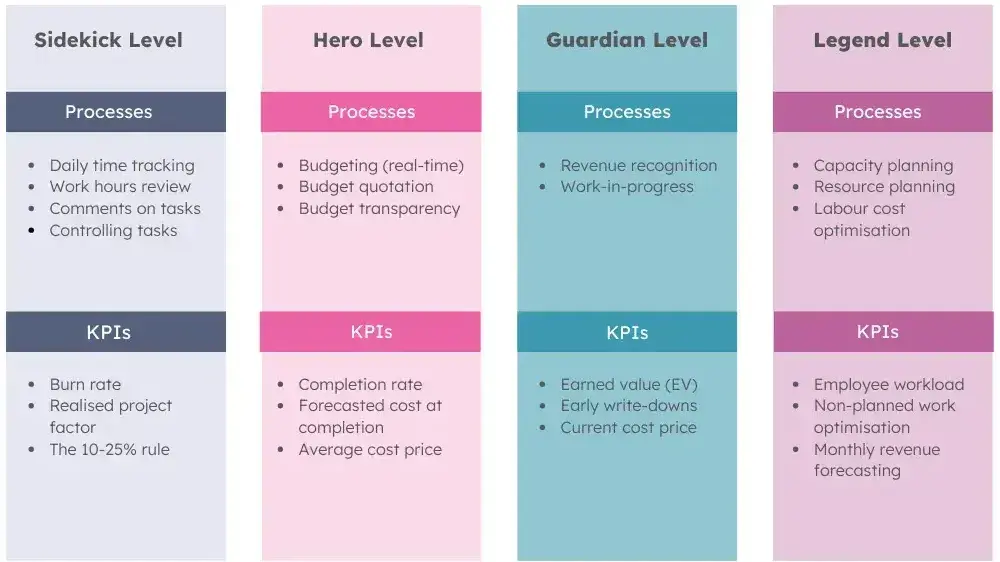
Drawing upon more than two decades of experience collaborating with professional services organisations in the Nordics, our project management maturity model is finely tuned to deliver relevance and effectiveness within the industry.
It consists of four levels, and for each level, we describe the specific processes and key performance indicators (KPIs) you must master to elevate your project profitability.
In this blog, we focus on the intermediate level of project financial management, also known as:
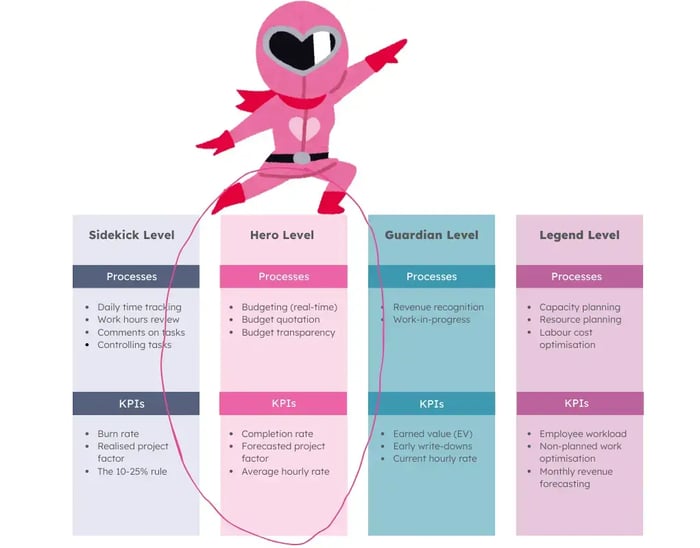
When the company has processes related to daily (or almost daily) time tracking implemented and high-quality data comes in, you’re ready for the hero level. This level is all about utilising the data to budget and forecast.
Also read: Comparing the best project management tools
When you create a budget with real-time data, you can see early on if the project should be adjusted in scope, budget, and/or resources.
Make a habit of comparing the progress to the expectations and total hours consumed weekly or bi-monthly.
Also read: Mastering Project Budgeting: A comprehensive guide
Another process at the hero level is budget quotation. A budget quotation is like a rough estimate of the project done as part of the client proposal before the project is begun.
Budget quotations allow you to understand how you saw this project before (or when) it began.
It sounds simple, but we see many customers start projects without a quotation and then, well into the project, try to reach a forecast and gain control of the project.
Another benefit of budget quoting on all projects is ensuring you have thought projects properly through.
When the data and process are in place, you can do “light” forecasting, constantly comparing the project's expectations to reality.
Also read: The effective project plan - the project manager's ultimate guide.

Use the TimeLog report called full project overview to closely follow project factors, average hourly rate, budget vs actual and much more!  p
p
The third process, budget transparency, is more about transparent communication than actual budgeting.
When you have the budget in place, data is coming in, and you follow the ups and downs closely, a core process as the project manager is to communicate with transparency:
Also read: Looking for an easy template to project budget in Excel? We've got you!

And that brings up to:
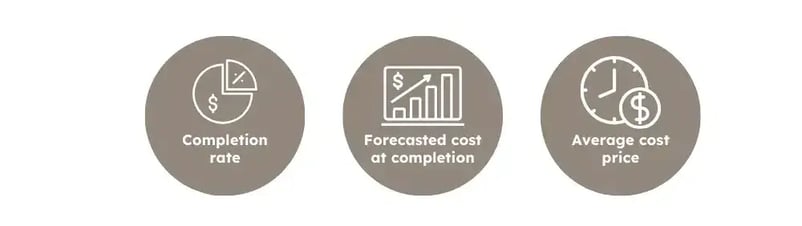
The completion rate, also known as the budget at completion (BAC), measures how much of the allocated budget has been expended or utilised relative to the total budget for a specific project.
It gives you insights into the financial health of your project by assessing whether spending is on track with the planned budget.
How do you forecast your project's cost (and potential profitability)? As with many KPIs used to steer project finances, you have multiple ways to reach your goal (or, in this case, prognosis and forecast what you’ll be losing or gaining). The method we’ll present is performance-based cost forecasting.
The good news is that to forecast cost, you can use this universal formula:
The actual cost (AC) is shown in TimeLog or similar programs.
The bad news is that the above formula doesn’t include how much money will be spent to complete the project, which is the ETC.
If it were easy, we could assume that the ETC would be the budget at completion (BAC)—which you already know the formula for—minus the actual cost (AC).
Sadly, this would “only” show you how much of the budget is left. Not the cost of the work left. To calculate this, you need to add earned value (EV)—a KPI from the guardian level—to the mix:
But the fun doesn’t stop here.
When you use performance-based cost forecasting, which makes 100% sense when you work in a PSO, you also need to consider performance.
This means you need to factor in the performance factor.
While the reason for this is simple: Bad performance means you need more time or money to finalise the project, the formulas for determining the performance factor are a bit more complex.
The Matryoshka Effect of Project Financial Management
If you feel like our current calculation journey to pinpoint the estimate at completion (EAC) resembles the Matryoshka Effect (also called the Russian Doll Effect), where multiple layers or components resemble each other, each layer fitting within the one before it, you wouldn’t be entirely wrong.
The formulas for determining the performance factor are complex. One reason is that performance changes throughout the project lifecycle. So, you can’t rely on the same formula to predict the performance factor.
For instance, at the beginning of a project, team members must learn about the project, the scope of work, and so on. And you typically don’t experience many changes; things are steadier at the beginning.
But suppose you don’t feel like using five (!) different formulas to calculate the EAC.
In that case, you can use TimeLog, which gives project managers an agile bottom-up approach to estimate ETC and calculate EAC.
Get the e-book: Level Up Your Project Financial Management now
This is a true power KPI and helps you identify if your project is getting out of control.
Measuring the average cost price requires getting that information for every time registration in the project, which you can do with TimeLog PSA.
When you start measuring this KPI, you’re able to:
Also read: Intro to project financial management and the 9 KPIs you need to measure

TimeLog offers a cutting-edge Professional Services Automation solution that prioritises project financial management. Our platform makes it easy to monitor the profitability of consultants, projects, and clients.
Are you interested in learning more about how TimeLog PSA can help you achieve profitable and successful projects? Schedule a 20-minute meeting with us today.



/AI-Generated%20Media/Images/project%20budgeting-1.jpeg)